
Electronic waste is the fastest growing waste stream in the world. According to the United Nations, the world generated over 60 million tonnes of e-waste in 2022, and that figure is rising every year as technology cycles shorten and more devices enter circulation globally.
Australia is not insulated from this trend. Australians are among the highest generators of e-waste per person in the world, producing around 25 kilograms per person annually. A significant portion of that goes to landfill or informal disposal rather than recycling, despite the availability of responsible alternatives.
The environmental consequences of that gap are real, measurable, and in many cases long-lasting. This article covers the specific environmental benefits of recycling electronic waste properly, what happens when it doesn’t get recycled, and why the choice between responsible and informal disposal has consequences well beyond the device itself.
The Problem with E-Waste in Landfill
Electronics Are Not Inert Waste
Most household and office waste in landfill breaks down over time, slowly and imperfectly, but it degrades. Electronics do not behave the same way.
The materials inside electronic devices, metals, plastics, glass, and chemical compounds, are engineered for durability and performance. In a landfill environment, that durability works against the environment rather than for it.
Hazardous Materials Leach Into Soil and Groundwater
Electronic devices contain a range of hazardous materials that become environmental contaminants when they reach landfill.
Lead, present in solder joints, older CRT screens, and circuit board components, leaches into soil and groundwater over time. Mercury, found in certain display backlights and switches, is a potent neurotoxin that accumulates in ecosystems and enters the food chain through contaminated water sources.
Cadmium, used in some rechargeable batteries, is a known carcinogen that persists in soil for decades. Brominated flame retardants, used extensively in circuit boards and plastic casings, release toxic compounds when they break down or are incinerated.
The Scale Makes It a Systemic Problem
A single device in landfill creates a localised contamination risk. Millions of devices in landfill, across thousands of sites over decades, create a systemic environmental problem that is expensive and in some cases impossible to fully remediate.
The environmental benefit of recycling electronics is not just about the individual device. It is about the cumulative impact of removing hazardous materials from a waste stream that would otherwise carry them into soil, water, and ecosystems at scale.
Benefit 1: Keeping Hazardous Materials Out of the Environment
What Gets Removed from the Waste Stream
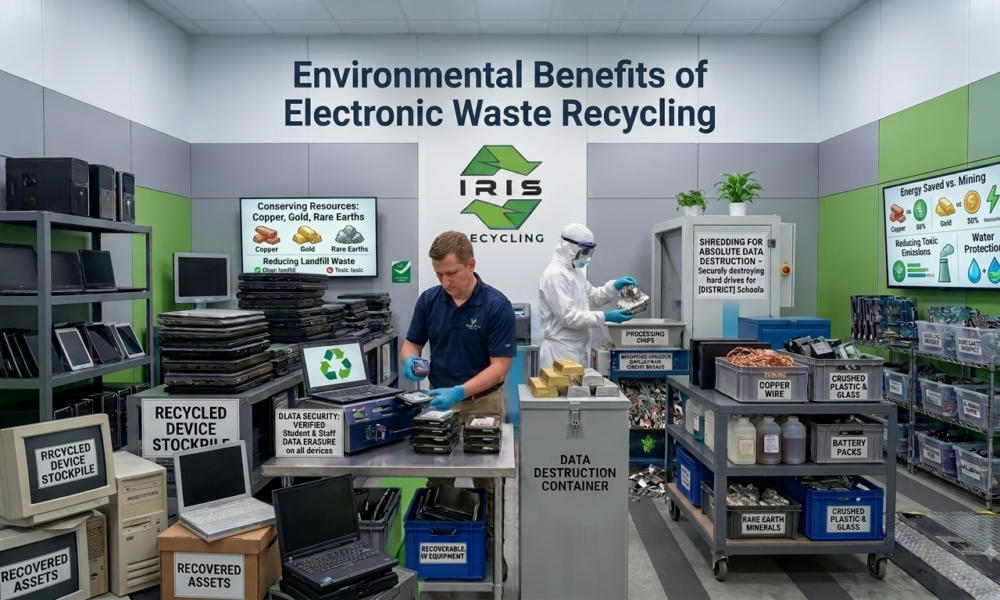
Responsible e-waste recycling intercepts hazardous materials before they reach landfill and routes them to specialist handlers equipped to process them safely.
Lead is separated and processed by licensed smelters. Mercury is captured and handled under strict environmental controls. Cadmium from batteries is processed through dedicated battery recycling streams. Brominated flame retardants are managed by processors with the appropriate facilities to handle them without releasing toxic byproducts.
Why This Matters Beyond Compliance
Keeping these materials out of landfill isn’t just a regulatory checkbox. It prevents contamination that would otherwise affect local soil quality, groundwater sources, and the broader ecosystems connected to disposal sites.
For businesses and schools generating e-waste at volume, responsible disposal means their retired devices are not contributing to that contamination, a measurable environmental outcome rather than a symbolic one.
Benefit 2: Recovering Valuable Raw Materials
Electronics Are a Rich Source of Recoverable Materials
One of the less-understood environmental benefits of e-waste recycling is the materials it returns to productive use.
Electronic devices contain significant quantities of recoverable metals. Copper is present in wiring, circuit boards, and motors. Aluminium is used in casings, heat sinks, and structural components. Gold, silver, palladium, and platinum appear in circuit board connectors and contacts in concentrations that are often higher per tonne than in raw ore bodies.
This is why e-waste is sometimes referred to as urban mining. The recoverable material value in a tonne of circuit boards can exceed the value of a tonne of mined ore for several precious metals.
Secondary Materials Displace Virgin Extraction
When materials are recovered from e-waste and returned to manufacturing supply chains as secondary raw materials, they displace the need for new raw materials to be extracted.
Mining is one of the most environmentally intensive industrial activities on the planet. It involves land clearing, energy-intensive extraction and processing, significant water consumption, and the generation of tailings and waste that create long-term environmental liabilities.
Every tonne of copper recovered from recycled electronics is a tonne of copper that doesn’t need to be mined. Every kilogram of gold recovered from circuit boards reduces demand for gold mining operations with significant land and water impacts.
Rare Earth Elements and Critical Minerals
Electronic devices also contain rare earth elements and critical minerals that are essential to modern manufacturing but geographically concentrated in their natural deposits.
Elements like neodymium, used in motors and speakers, indium, used in display screens, and cobalt, used in lithium-ion batteries, are present in devices that would otherwise go to landfill. Recovering them through e-waste recycling reduces dependence on primary extraction from deposits that are often located in environmentally sensitive or geopolitically complex regions.
Benefit 3: Reducing Energy Consumption in Manufacturing
Making New Components Is Highly Energy Intensive
Manufacturing new electronic components from raw materials requires significant amounts of energy at every stage, from mining and refining raw materials to fabricating components and assembling finished devices.
The energy cost of producing a new laptop, for example, is dominated by the manufacturing phase rather than the use phase. Most of the energy a laptop will ever consume in its lifetime is used before it ever leaves the factory.
Recycled Materials Require Substantially Less Energy to Process
Processing secondary materials recovered from e-waste requires a fraction of the energy needed to produce the same materials from raw ore.
Recycling aluminium, for instance, uses around 95% less energy than producing aluminium from bauxite ore. Recycling copper requires approximately 85% less energy than primary copper production. The energy savings from using recycled materials across the full volume of e-waste processed annually represent a significant reduction in industrial energy demand and associated emissions.
Refurbishment Multiplies the Energy Benefit
When a device is refurbished and returned to active use rather than being dismantled for material recovery, the energy benefit is even greater.
A refurbished laptop displaces the full manufacturing energy cost of a new device. The energy already embedded in the existing device continues to provide value rather than being written off, and no new manufacturing energy is required to replace it.
Benefit 4: Extending the Life of Products and Components
Refurbishment Keeps Devices in Use Longer
Not every device collected through e-waste recycling is immediately dismantled for materials. Devices in reasonable condition are assessed for refurbishment, repaired if necessary, and returned to productive use.
A laptop refurbished from a business IT refresh may continue in active use for several more years in a different context, as a school device, a community program resource, or a lower-cost device for a small business. That extended useful life directly reduces the demand for new device manufacturing.
Component Harvesting Extends Individual Parts
Devices too old or damaged for full refurbishment can still yield working components. RAM modules, processors, screens, batteries, and power supplies harvested from retired devices extend the useful life of those parts beyond the life of the device they came from.
Component harvesting requires skilled assessment and careful disassembly, but when done well, it significantly reduces the volume of material that needs to go through full material recovery processing.
Benefit 5: Reducing Carbon Emissions Across the Supply Chain
E-Waste Recycling Has a Measurable Carbon Benefit
The combination of reduced mining activity, lower manufacturing energy consumption, and extended product lifetimes through refurbishment adds up to a measurable reduction in carbon emissions across the electronics supply chain.
Studies consistently find that recycling and reusing electronic devices produces significantly lower lifecycle carbon emissions than manufacturing new devices from virgin materials. For organisations with carbon reduction targets or net-zero commitments, responsible e-waste disposal is a quantifiable contribution to those goals.
Avoiding Incineration Reduces Direct Emissions
In some regions, e-waste that isn’t recycled is incinerated rather than landfilled. Incineration of electronics releases toxic compounds including dioxins and furans from burning brominated flame retardants, as well as direct carbon emissions from the incineration process itself.
Responsible recycling avoids both outcomes, keeping hazardous combustion byproducts out of the atmosphere and the material value in productive use rather than converting it to emissions.
Benefit 6: Supporting a Circular Economy
Linear vs. Circular: What the Difference Means
The conventional model for manufactured goods is linear: raw materials are extracted, products are manufactured, used, and then discarded. E-waste represents one of the clearest examples of how that model creates environmental problems at scale.
A circular economy model aims to keep materials in productive use for as long as possible, through reuse, repair, refurbishment, and recycling, before material recovery as a last resort rather than a first response.
E-Waste Recycling Is One of the Most Practical Applications
Electronics are well-suited to circular economy principles because they contain valuable and recoverable materials, because individual components often outlast the devices they come from, and because refurbished devices have genuine market demand.
Responsible e-waste recycling contributes directly to circular economy outcomes, keeping materials in use, reducing demand for virgin extraction, and returning recovered materials to productive supply chains rather than treating every retired device as waste to be disposed of.
The Role Businesses and Schools Play
Businesses and schools generating e-waste at volume have an outsized influence on how well the circular economy functions in practice.
A single business IT refresh that recycles rather than landfills a hundred devices removes a significant volume of hazardous material from the waste stream, returns recoverable metals and components to productive use, and reduces the manufacturing demand that would otherwise be needed to replace those devices without a circular model.
At scale, those individual decisions add up to a meaningful environmental outcome.
The Case for Responsible E-Waste Recycling
It Addresses Multiple Environmental Problems at Once
Responsible e-waste recycling is one of the few waste management decisions that simultaneously addresses hazardous material contamination, resource recovery, energy efficiency, carbon reduction, and circular economy participation in a single action.
Most environmental initiatives require trade-offs or separate programs to address separate problems. E-waste recycling, done properly, addresses all of these at once.
The Alternative Has Measurable Costs
Every tonne of e-waste that goes to landfill rather than recycling represents hazardous materials in the environment, recoverable resources that are permanently lost, energy and emissions that didn’t need to be generated, and manufacturing demand that didn’t need to be met with virgin materials.
These are not abstract costs. They are measurable environmental outcomes with real consequences for soil, water, ecosystems, and climate.
Recycle Your Electronics with IRIS Recycling
E-waste is a global environmental problem. What your business or school does with its old devices is the part you can actually control.
IRIS Recycling makes that part straightforward. Free pickup across Greater Sydney, zero-landfill processing for every device, and no cost for business and school collections regardless of volume.