
Most people hand over a bag of old phones, laptops, or cables at a recycling drop-off point and consider the job done. The devices disappear, the guilt lifts, and nobody thinks much about what comes next. For the majority of people, the story ends at the collection point.
But what actually happens after that is one of the more complex and genuinely interesting supply chains in modern waste management, and understanding it matters more than most businesses and schools realise. Because how a device is handled after collection determines whether “recycling” is actually recycling, or just a more responsible-sounding word for landfill by another route.
This article walks through what a responsible electronics recycling process looks like from the moment a device is collected to the point where its materials re-enter the supply chain, and why the difference between a good process and a poor one has real consequences for your business.
Step 1: Collection and Logging
The process begins before a single device is opened or sorted. When electronics are collected from a business, school, or drop-off point, a responsible recycler logs every item at the point of pickup. This creates the beginning of a chain of custody, a documented record that follows each device through every stage of the process.
For businesses, this logging step is important beyond just good record-keeping. It establishes the starting point of a verifiable chain that can be referenced for Privacy Act compliance, sustainability reporting, or internal audit purposes. A collection that happens without any logging or documentation is a collection with no accountability attached to it.
At this stage, devices are transported to a processing facility, kept separate from general waste and handled as a distinct category of material because that is exactly what they are.
Step 2: Data Destruction Before Anything Else
Before any device is opened, assessed, or sorted, every storage device goes through secure data destruction. This step happens first, not partway through the process, and not after refurbishment assessment.
The reason for this sequence is straightforward. Once a device enters a processing environment, it may pass through multiple hands across sorting, testing, dismantling, and material recovery. Data destruction before any of that happens ensures no storage device with recoverable data ever moves further into the process, regardless of what happens after.
For businesses and schools, this is the step that closes the compliance gap under the Privacy Act 1988 and the Australian Privacy Principles. It is also the step that most casual or informal recycling arrangements skip entirely, which is why handing devices to a general waste removalist or an unlicensed collector creates real liability rather than resolving it.
Software-based erasure using a recognised standard such as DoD 5220.22-M or NIST 800-88 handles functioning drives. Drives that are too damaged or degraded to complete a software wipe are physically destroyed instead, shredded or degaussed so no data-bearing component continues through the process intact.
Step 3: Sorting and Grading
Once data destruction is complete, devices move into sorting. This is where the fate of each item starts to diverge based on its condition, age, and functionality.
Sorting at a responsible facility is more precise than most people imagine. Devices aren’t simply split into “working” and “broken.” They’re assessed against a range of criteria:
- Can the device be refurbished and reused?
- Can individual components be harvested and reused in other devices?
- Is the device too degraded for reuse but still viable for material recovery?
- Does it contain hazardous materials requiring specialist handling?
The outcome of this assessment determines which processing stream each device enters. A laptop in reasonable condition with working components might be refurbished. A server too old for reuse might be dismantled for component harvesting. A monitor with a cracked panel and degraded internals goes straight to material recovery.
This grading step is what separates genuine recycling from bulk processing. Without it, working components get shredded alongside junk, and recoverable value is lost before it’s even identified.
Step 4: Refurbishment and Reuse
Devices that pass the sorting assessment enter the refurbishment stream. Here, technicians clean, repair, test, and prepare devices for reuse, either as complete units or as donor devices for components.
Refurbishment is arguably the most valuable outcome in the electronics recycling process from both an environmental and economic standpoint. A refurbished laptop that returns to active use displaces the need for a new device to be manufactured, which avoids the full environmental cost of producing new components, sourcing raw materials, and running a manufacturing supply chain.
For the circular economy, refurbishment is the preferred outcome. Recycling materials is better than landfill, but reusing a complete device is better than recycling it.
Devices refurbished from business and school collections sometimes find a second life in community programs, educational initiatives, or lower-cost device markets, extending their useful life rather than treating them as immediately spent.
Step 5: Component Harvesting
Devices that are too old or damaged for full refurbishment but still contain working parts enter component harvesting. Here, individual components such as RAM, processors, batteries, screens, and power supplies are carefully removed and tested for reuse in repairs or other devices.
Component harvesting requires skilled labour and a systematic approach to be economically and environmentally worthwhile. Done well, it significantly extends the useful life of individual parts beyond the life of the device they came from. A laptop with a failed motherboard might still yield a perfectly functional screen, battery, and keyboard that each go on to serve another device for years.
This step also applies to peripheral equipment. Networking gear, cables, and power supplies often contain components with significant remaining life that would be wasted if the entire unit went straight to material recovery without assessment.
Step 6: Dismantling and Material Recovery
Devices that can’t be refurbished or harvested for components move into dismantling for material recovery. This is what most people picture when they think of recycling, but the reality is more structured and more technical than the word “recycling” usually suggests.
Modern electronics are composed of a surprising range of valuable and recoverable materials:
Metals
Copper is present in wiring, circuit boards, and motors. Aluminium is used extensively in casings, heat sinks, and structural components. Steel and iron appear in frames, brackets, and drive housings. Gold, silver, palladium, and platinum are present in small but meaningful quantities in circuit boards and connectors, which is why e-waste is sometimes referred to as “urban mining”. The concentration of precious metals in electronics is often higher per tonne than in raw ore.
Plastics
Casings, keyboard components, and internal housing are typically made from various grades of plastic. Some are recyclable into new products. Others require specialist handling due to the presence of flame retardants or other additives that make standard plastic recycling inappropriate.
Glass
Monitor and screen glass, particularly from older CRT monitors, requires careful handling and specialist processing due to its lead content and the specific type of glass used in display manufacturing.
Hazardous Materials
Electronics contain a range of materials that require specialist handling rather than standard recycling: lead in solder and older screens, mercury in certain backlights and switches, cadmium in some batteries, and brominated flame retardants in circuit boards and casings. These materials are why e-waste cannot go to general landfill, and why informal or unlicensed recycling creates environmental risk regardless of how well-intentioned it is.
Responsible dismantling separates these material streams carefully so each goes to the appropriate downstream processor. Metals go to smelters or refiners. Plastics go to processors equipped to handle their specific composition. Hazardous materials go to licensed handlers with the appropriate facilities.
Step 7: Downstream Processing and Re-entry Into Supply Chains
Recovered materials don’t simply disappear after collection. They re-enter manufacturing supply chains as secondary raw materials, displacing the need for virgin materials to be extracted and processed.
Copper recovered from e-waste goes back into electrical manufacturing. Gold and silver recovered from circuit boards re-enter the precious metals supply chain. Aluminum is smelted and reused in new products. Even plastics that can be safely recycled find their way into new manufactured goods.
This is the point at which “recycling” in the truest sense is actually complete. The device has been collected, the data has been destroyed, the useful life has been extended where possible, and the remaining materials have returned to a supply chain where they displace the environmental cost of new extraction.
The difference between this outcome and landfill is not just environmental. It’s economical. Materials recovered from e-waste have genuine market value, which is part of what makes responsible recycling financially viable as a service rather than just an obligation.
What Happens When the Process Goes Wrong
Not every e-waste recycler runs the process described above. Some collect devices and send bulk loads to overseas processing facilities with lower environmental and labour standards. Some skip the sorting and grading step and process everything in bulk, losing the refurbishment and component recovery value entirely. Some don’t verify data destruction and pass devices through with storage media still intact.
For businesses, the consequences of choosing the wrong recycler aren’t limited to environmental outcomes. A provider that skips data destruction creates unresolved data liability. A provider that exports bulk e-waste without documentation creates compliance risk under Australian environmental law. A provider with no chain-of-custody logging leaves you with no evidence of responsible disposal if ever questioned.
The process matters as much as the intention.
Recycle Your Electronics the Right Way
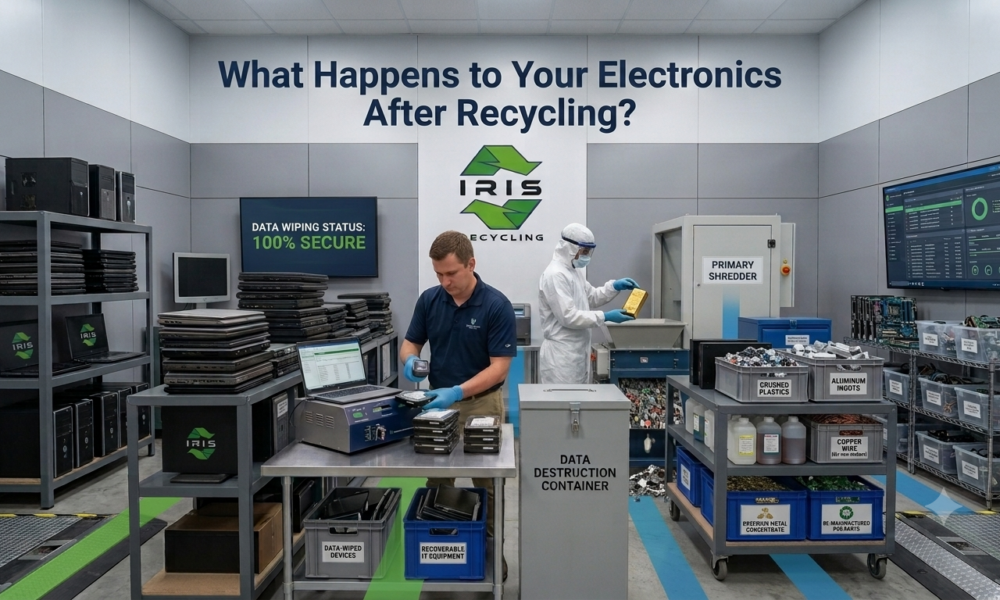
At IRIS Recycling, every device collected from businesses and schools across Sydney goes through the full process: chain-of-custody logging, Active@ KillDisk data destruction before anything else happens, thorough sorting and assessment, and zero-landfill processing from collection through to material recovery.
Free pickup and drop-off is available for businesses and schools across Greater Sydney, with no cost and no minimum contract. Book a free pickup with IRIS Recycling today.