
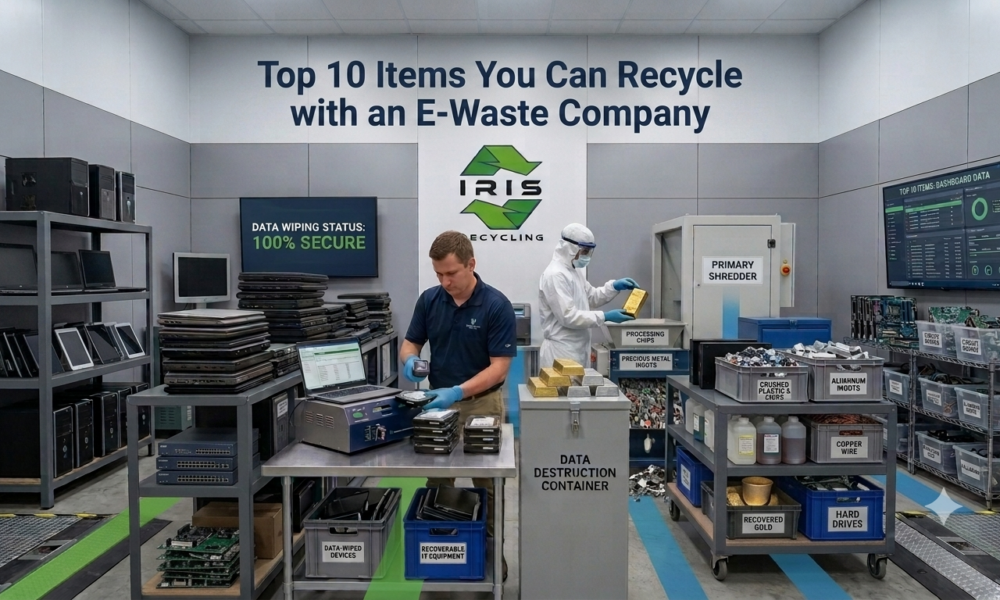
An e waste company accepts far more than just old phones and laptops. The category of items a specialist recycler can take is broader than most people realise, and some of the most commonly stockpiled items in office storerooms need specialist handling.
This list covers the top ten items you can recycle with an e waste company, what makes each one a specialist job rather than general waste, and why getting them to the right place matters beyond just clearing the space they take up.
Which Items Can You Recycle with an E Waste Company?
Desktops, laptops, servers, mobile phones and tablets, hard drives and storage media, networking equipment, audio visual and conferencing gear, cables and peripherals, printers and copiers, and batteries and power supplies can all be recycled through a specialist e waste company. Each carries either recoverable materials, sensitive data, or both, which is why general waste is not a suitable route for any of them.
What Makes Desktop Computers a Specialist Recycling Job?
Desktop computers are the most common item collected from business and school e waste pickups, since office refreshes and lab upgrades routinely produce dozens or hundreds of units at once. They contain copper wiring, aluminium casing, steel components and circuit boards carrying small quantities of gold, silver and palladium, alongside hazardous materials such as lead in solder.
Desktops connected to a network or used for work almost certainly hold recoverable data, so secure destruction is essential before any unit is processed, however long it has sat unpowered in storage. Our guide on laptop recycling and data security covers the same principle for laptops.
Why Do Laptops Need Specialist Handling?
Laptops are one of the highest volume items in business and school collections, particularly as refresh cycles shorten. Each contains a dense mix of components in a compact form, including a lithium ion battery, an LCD screen, circuit boards, and an aluminium or magnesium alloy casing. Lithium ion cells are classified as hazardous material and cannot go to general waste because of fire and chemical risk.
Laptops assigned to individual staff are among the higher risk devices in any collection, since they may hold saved logins and documents that were never cleared before return. Secure erasure before processing is not optional, as explained in our hard drive destruction guide.
Why Are Servers Both High Value and High Risk?
Servers are high value because they contain significant quantities of recoverable metals and components, and high risk because they typically hold more concentrated business data than any other device in the organisation. A single server may hold years of business records and customer databases, which makes it the device where data destruction matters most.
For businesses decommissioning server infrastructure during a migration or office closure, specialist collection with verified destruction is the only appropriate route.
Why Are Mobile Phones and Tablets Often Overlooked?
Mobile phones are perhaps the most mismanaged category of business e waste, because they are small and easy to forget in a drawer or cupboard. A retired business mobile or tablet is a data risk in the same way a laptop is, sometimes more so given the personal and professional data that passes through it.
Smartphones contain lithium ion batteries, rare earth elements, and gold and silver in circuit boards, materials that are genuinely valuable to recover and genuinely harmful if landfilled. For a fleet of retired mobiles or tablets, bulk collection through a specialist recycler is a straightforward way to clear the backlog responsibly.
Why Do Hard Drives and Storage Media Need Separate Handling?
Hard drives, SSDs, USB drives, and memory cards hold data in the most concentrated form of any component in a system, and they are small enough to be overlooked in a bulk collection if nobody accounts for them specifically. A drive that is not collected through a formal process can end up in general waste, a drawer indefinitely, or with someone who can recover whatever remains on it.
Specialist recyclers treat storage media as its own category, applying secure erasure or physical destruction before any drive moves further through processing. Our guide to why secure data destruction is essential before recycling computers explains why this step comes first.
Does Networking Equipment Need to Be Wiped Too?
Switches, routers, modems and access points are routinely replaced during office upgrades and provider switches, and just as routinely sit in storage with no disposal plan. They contain recoverable copper, steel and aluminium, and often hold configuration data including network credentials and access logs that should be cleared before disposal.
A factory reset usually suits consumer grade equipment, but business grade switches and routers used in larger environments may hold more sensitive configuration data worth formally wiping.
What About Audio Visual and Conferencing Equipment?
Projectors, video conferencing units, speakers, amplifiers and display screens are a growing category as organisations upgrade meeting rooms. They tend to be bulky and expensive to remove, and are not an obvious fit for standard recycling channels.
Older lamp based projectors contain mercury requiring specialist handling, so sending one to general waste can create a compliance issue if it ruptures. Specialist recyclers accept audio visual equipment and route the components that need specialist processing accordingly.
Can Cables and Peripherals Be Recycled Too?
Cables are the item most businesses assume can go in the general bin, but electrical cables are made primarily of copper wire, one of the most valuable and recoverable materials in the recycling chain. Recycled copper re enters the manufacturing supply chain as a secondary material, displacing the need for new copper to be mined.
Keyboards, mice, headsets, webcams and docking stations also fall into this category. None carry the same data risk as computers or storage media, but all contain materials that warrant e waste processing rather than general disposal, as our environmental benefits of electronic waste recycling guide explains.
Do Printers and Copiers Belong in an E Waste Collection?
Yes, and they are one of the most overlooked items in an office or school clearout. Printers and multifunction copiers contain circuit boards, motors, and metal components suitable for recovery, alongside toner or ink cartridges that need separate specialist processing rather than general disposal.
Many office printers and copiers also hold internal drives that store copies of scanned, printed, or faxed documents. That makes data destruction relevant here too, particularly for a leased device being returned or a shared office machine reaching the end of its life.
Why Do Batteries and Power Supplies Need Their Own Process?
Standalone batteries, uninterruptible power supplies and external power packs are hazardous waste in their own right, separate from the devices they power. Lithium ion and lead acid batteries can short circuit, overheat, or catch fire if crushed or damaged in a general waste stream, which is why they need dedicated handling.
Power supplies and UPS units also contain recoverable metals and, in older units, materials that require licensed processing. Route them through the same collection as your other e waste rather than storing or disposing of them separately.
What Does This Mean for Your Business or School?
Electronics need specialist handling for two reasons, the data they may contain and the materials they are made from. That means the right disposal route is not a general waste contractor or a charity drop off without a data destruction step. It is a specialist e waste recycling service with a documented process for both.
The good news is that for most businesses and schools, the full list above can be collected in a single visit rather than managed as ten separate logistics problems. Our guide on why offices need professional electronic waste disposal explains how to set that up.
Frequently Asked Questions
Can I recycle a broken projector or conferencing unit?
Yes. Working or broken, projectors and conferencing equipment should go through a specialist recycler, not general waste. Older lamp based projectors in particular contain mercury that needs specialist handling, so include them in your next scheduled e waste collection.
Do cables and chargers really need to be recycled separately from the bin?
Cables are made mostly of copper wire, a valuable and fully recoverable material. Putting them in general waste wastes a resource that could return to manufacturing instead of going to landfill, so bundle them in with your next scheduled device collection.
Are old office batteries and UPS units accepted for recycling?
Yes. Lithium ion and lead acid batteries, along with uninterruptible power supplies, need dedicated handling because they can overheat or catch fire if damaged in general waste. Include them alongside your other devices in a scheduled collection rather than storing or binning them separately.
Does my business need to wipe data from a printer or copier before recycling?
Often, yes. Many office printers and multifunction copiers store copies of scanned, printed or faxed documents on an internal drive, so treat them the same way you would a computer. Ask your recycler to confirm whether erasure applies to your specific model before it is collected.
Is there a limit to how many item types can go in one e waste collection?
No. IRIS Recycling is designed for bulk, mixed collections, so desktops, laptops, servers, phones, printers, batteries, and cables can all go in the same scheduled visit. That means one call clears every category on this list rather than several separate trips.
Recycle All of It in One Collection with IRIS Recycling
At IRIS Recycling, we accept all of the items above from businesses and schools across Sydney. Our free pickup service is designed for bulk collections, whether that is a single computer lab’s worth of equipment or a full office fit out covering every category on this list.
Every device goes through secure data destruction before processing, everything is handled with a zero landfill commitment, and there is no cost for business and school collections. IRIS holds a 5.0 rating from more than 100 reviews, and our guide on where to recycle laptops in Sydney for free explains how collections work.
Ready to clear every item on this list in one visit? Book your free e waste pickup with IRIS Recycling today.