Every business reaches that point, a storage room quietly filling up with old laptops, retired desktops, decommissioned servers, and networking gear that nobody uses anymore but nobody knows what to do with. It sits there for months, sometimes years, because “we’ll sort it out later” always feels less urgent than everything else on the list.
But old IT equipment isn’t just clutter. It carries real risk, financial, legal, and reputational, if it’s disposed of the wrong way. And in Australia, that risk comes with a regulatory framework businesses are expected to follow whether they’re aware of it or not.
This guide walks through how businesses can dispose of old IT equipment safely, what the actual risks are, and what a responsible process looks like from collection through to recycling.
Why IT Equipment Disposal Is a Business Risk, Not Just a Logistics Problem
Most businesses treat old tech as a facilities issue. Clear it out, call a removalist, done. But IT equipment is fundamentally different from office furniture or general waste, because of what it contains.
A retired laptop isn’t just a piece of hardware. It’s a device that may still hold client emails, saved logins, financial records, HR files, and years of internal documents. The same goes for a decommissioned server, an old desktop from a departing employee, or a network switch that was replaced last quarter.
The data doesn’t disappear when a device is switched off or even when it’s formatted. Without proper erasure, it can often be recovered with basic software by whoever ends up with the device next.
For businesses handling personal information, and that covers almost every business operating today, the Privacy Act 1988 and the Australian Privacy Principles (APPs) require that personal data be destroyed or de-identified when it’s no longer needed. That obligation follows the device, not just the person who used it. Disposing of a device without verified data destruction is a compliance gap, full stop.
What Counts as IT Equipment
Before getting into the process, it’s worth being clear about scope. Safe disposal applies to any device capable of storing data, which is broader than most businesses initially assume:
- Desktop computers and all-in-ones
- Laptops and notebooks
- Servers and server racks
- Network switches, routers, and modems
- Hard drives and SSDs (including external drives)
- USB drives and memory cards
- Tablets and mobile devices
- Monitors, printers, and scanners
- Audio-visual and conferencing equipment
- Cables, peripherals, and accessories
If a device has ever connected to your network or touched company data in any form, it falls within the scope of secure IT disposal.
The Risks of Getting IT Disposal Wrong
Understanding what can go wrong is the clearest way to understand why a proper process matters.
Data Breach Exposure
The most serious risk. A device that leaves your business without verified data erasure can be recovered, resold, or accessed by a third party. Data breaches involving personal or financial information trigger mandatory reporting obligations under the Notifiable Data Breaches (NDB) scheme, along with potential regulatory action from the Office of the Australian Information Commissioner (OAIC).
Privacy Act Non-Compliance
Under the Australian Privacy Principles, businesses are required to take active steps to destroy personal information they no longer need. Informal deletion, sending devices to a general rubbish skip, or donating devices without wiping them doesn’t meet that standard.
Environmental and Legal Liability
E-waste contains hazardous materials including lead, mercury, cadmium, and brominated flame retardants. Disposing of IT equipment in general waste or landfill is prohibited under Australian environmental regulation. Businesses that do so, even unknowingly, can face fines and liability.
Reputational Damage
Beyond regulatory consequences, a data breach or improper disposal incident involving company or customer information creates reputational damage that’s hard to undo, particularly for businesses in finance, healthcare, education, or professional services.
Data Deletion vs. Data Destruction: What Is the Difference
This distinction matters more than most businesses realise.
Data deletion removes the visible file or folder. The underlying data remains on the drive and can often be recovered with freely available software. This includes recycle bin deletion, simple formatting, and even factory resets on some devices.
Data destruction overwrites the actual data on the drive, making it unrecoverable. The most widely recognised standard for this is the U.S. Department of Defense DoD 5220.22-M method, which overwrites data multiple times to prevent any form of reconstruction.
For businesses, data destruction is the only method that satisfies the requirements of the Privacy Act and the Australian Privacy Principles. Deletion, regardless of how thorough it feels, does not.
How to Dispose of Old IT Equipment Safely: A Step-by-Step Process
Step 1: Audit What You Have
Before anything is collected or disposed of, complete an asset audit. List every device by type, age, and whether it has ever held company or customer data. This gives you a clear scope for the disposal process and a starting record for chain-of-custody documentation.
Step 2: Separate Data-Bearing Devices
Not all IT equipment carries the same risk. Cables, keyboards, and most peripherals don’t hold data. Computers, laptops, servers, drives, tablets, and mobile devices do. Separating them early ensures the right process is applied to the right equipment.
Step 3: Do Not Attempt DIY Erasure on Business Devices
Consumer-grade deletion tools and manual formatting are not sufficient for business devices holding personal or financial data. This is where a professional e-waste recycling and destruction service becomes the appropriate solution rather than an optional extra.
Step 4: Engage a Specialist E-Waste Recycling Partner
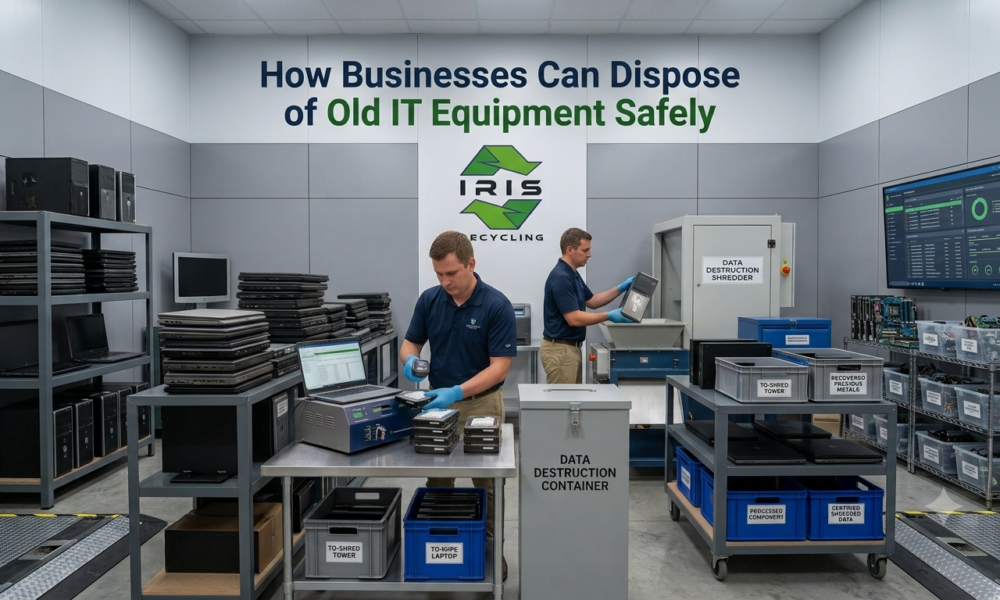
A specialist business e-waste recycling service handles collection, chain-of-custody logging, data erasure to a recognised standard, and zero-landfill processing in one coordinated process. This is both the safest and most practical option for businesses disposing of any volume of IT equipment.
Step 5: Request Documentation
For compliance and audit purposes, request written confirmation that your devices went through a verified data destruction process. This closes the chain of custody from your business to the point of erasure and gives you a record if ever questioned under the NDB scheme or a Privacy Act audit.
Step 6: Confirm Zero-Landfill Processing
Responsible e-waste recycling means materials are recovered and processed rather than sent to landfill. Confirm with your provider that this is how your equipment is handled, both for environmental compliance and sustainability reporting purposes.
When to Schedule IT Equipment Disposal
Most businesses don’t think about e-waste disposal until they’re forced to, which usually means scrambling during a move or finding a mountain of old equipment at the end of a financial year.
Building IT disposal into your regular business calendar makes the process simpler and the compliance risk easier to manage. Common trigger points include:
- IT refresh cycles (when new laptops or servers are deployed)
- Office relocations or downsizing
- End of financial year asset write-offs
- Lease returns or equipment upgrades
- Staff departures involving company-owned devices
- Mergers, acquisitions, or office closures
- End-of-term cycles for schools and educational institutions
Scheduling a collection around these natural moments means equipment is cleared promptly rather than accumulating, and the data risk is closed as part of the transition rather than left unresolved.
What to Look for in an E-Waste Recycling Partner
Not all e-waste services offer the same level of security or accountability. When evaluating a provider for your business, look for:
- A clearly documented data destruction process, not just a general claim that data is “wiped”
- A named, recognised erasure standard (DoD 5220.22-M, NIST 800-88, or equivalent)
- Chain-of-custody logging from collection through to processing
- Availability of compliance documentation on request
- A zero-landfill recycling commitment, not just removal
- A service model built for bulk business collection, not just individual items
Dispose of Your Business IT Equipment the Right Way
At IRIS Recycling, we provide free e-waste pickup and drop-off for businesses and schools across Sydney, with secure data erasure using Active@ KillDisk built into every collection. Every device we collect is erased before it’s processed, logged from collection through to recycling, and handled with a zero-landfill commitment.
If your business has old IT equipment sitting in storage, a refresh cycle coming up, or a move on the horizon, now is the right time to sort it.
Book a free pickup with IRIS Recycling today and clear your old IT equipment safely, securely, and at no cost to your business.