
Professional E waste disposal is a specialist service that collects retired office devices, destroys the data on them, and recycles the hardware, with documented proof at every step. Every office accumulates technology over time, and retired devices sit in a storage room until someone decides what to do with them.
The eventual answer is usually informal, such as a general waste contractor, a charity drop off or a skip bin during a move. It feels resolved, but it is really a liability that has become harder to trace. This article explains why offices need professional electronic waste disposal, what informal disposal risks and what a proper process looks like.
Why Do Offices Need Professional E Waste Disposal?
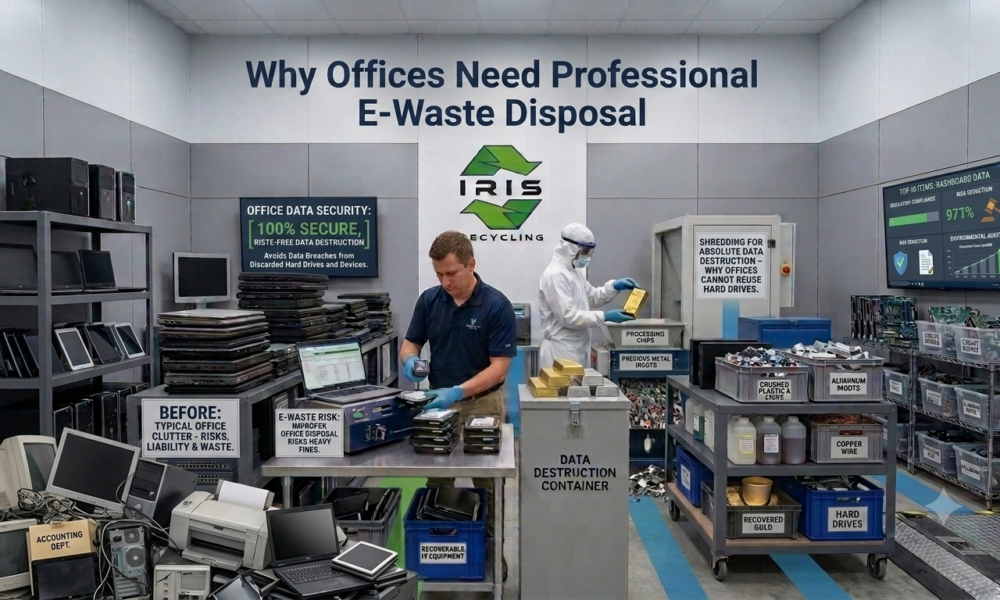
Because retired office devices hold sensitive data, privacy law expects that data to be destroyed, electronics contain hazardous materials, and general waste contractors cannot verify any of it. Professional disposal handles data destruction, environmental processing, and documentation together, which protects the office legally, financially, and reputationally.
How Big Is the Electronic Waste Problem in Australian Offices?
Refresh cycles are shortening as software outpaces older hardware, hybrid work has driven widespread device upgrades, and cloud migration has led many businesses to decommission on premise servers. Most offices now produce more electronic waste more often than they did five years ago, while disposal habits have not kept pace. Professional disposal bridges that gap by handling the volume, the data risk, and the compliance obligations that informal methods leave unaddressed.
Do Retired Office Devices Contain Sensitive Data?
What Is Stored on a Retired Office Device?
A computer used by one staff member for two or three years may hold locally saved documents, saved passwords, cached emails, internal login credentials and customer records. A decommissioned server may hold years of financial data, internal communications, and database content.
Why Is Switching Off or Deleting Not Enough?
Deleting files, basic formatting or handing a device to someone else removes visible access, not the data itself. It stays on the drive and can be recovered with freely available tools, which is why every device should be treated as a data risk until verified destruction is complete. Our hard drive destruction guide explains the methods.
What Does Professional Disposal Do Differently?
Verified data destruction is a standard step in the process, not an optional extra. Every device is treated as a data risk until the data has been verifiably removed, because that is exactly what it is.
Does Australian Privacy Law Make Professional Disposal Necessary?
What Does the Privacy Act Require?
Under the Privacy Act 1988 and the Australian Privacy Principles, organisations must destroy or anonymise personal information once it is no longer needed. That applies to data on retired devices just as it does to paper records. Informal disposal through a skip bin, second hand dealer or unlicensed collector leaves a gap in the chain of custody that exposes the office if anything goes wrong downstream, which is why secure data destruction is essential before recycling computers.
What Does the Notifiable Data Breaches Scheme Add?
If personal information is exposed because of improper disposal, the organisation must notify affected individuals and the Office of the Australian Information Commissioner, and regulatory action or penalties may follow. Professional disposal closes that gap with verified destruction and documented chain of custody logging, giving you the evidence trail to show you took the required steps.
Is Environmental Compliance Optional for Offices?
No. Electronics contain lead in solder joints, mercury in some backlights, cadmium in some batteries, and brominated flame retardants in circuit boards, all of which leach into soil and groundwater in landfill. Electronic waste should not go into general waste, and some states, including Victoria, ban it from landfill outright. Our guide to the environmental benefits of electronic waste recycling explains what proper processing achieves. Offices that use a general contractor without checking how it handles electronics may be creating an environmental compliance issue, particularly if the material is simply routed to landfill.
Why Are General Waste Contractors Not Equipped for Electronics?
A general waste contractor can clear and transport rubbish, but it cannot verify data destruction, keep chain of custody records, separate hazardous components, or route materials to downstream recyclers. The office ends up with no visibility and no documentation, so it is not disposing of the devices responsibly, regardless of what the contractor does with them next. Just as you would not use a general contractor to destroy confidential paper files, you should not use one for devices holding the digital equivalent.
How Real Is the Reputational Risk?
A data breach is usually a financial and regulatory problem first, but reputational damage compounds quickly once it becomes public. Improper disposal is one of the most avoidable causes, because device retirement is a predictable event that a structured process can manage. Our guide to laptop recycling and data security shows how one unmanaged laptop can become a breach. Offices that document their disposal properly are in a defensible position if an incident is ever investigated, and offices that do not are not.
Why Does Volume Make Professional Collection Practical?
An office refresh that replaces fifty laptops, or a server room decommission taking fifteen units out of service, is not suited to ad hoc drop off trips. A single scheduled pickup can clear the whole fleet, apply the same destruction standard to every unit, and produce one set of documentation. Our guide on how businesses can dispose of old IT equipment safely covers the wider process. For IT managers overseeing a refresh, that is a far lower administrative burden than managing informal disposal across dozens of devices, and for operations teams coordinating a move, it removes one logistical problem from an already complex process.
How Does Professional Disposal Support Sustainability Commitments?
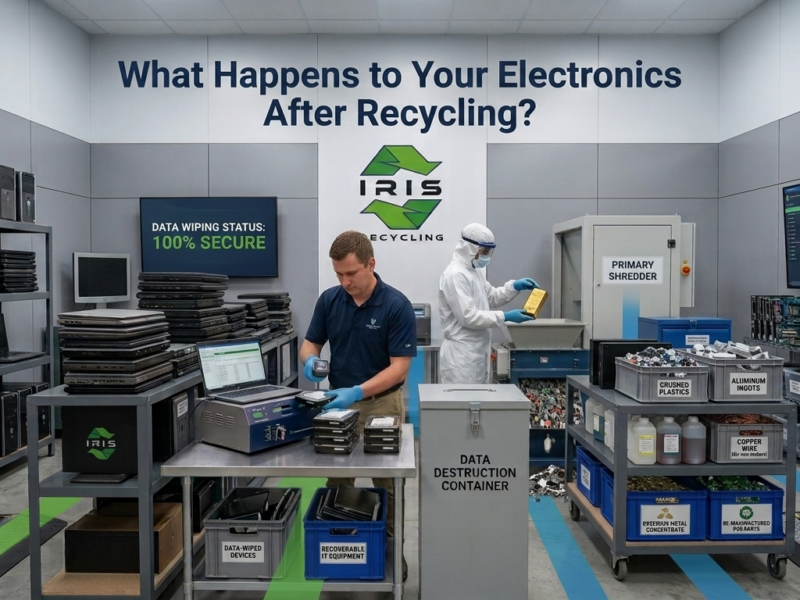
Offices using professional disposal can report the devices recycled, materials recovered, and landfill weight diverted, which is far more useful for ESG or sustainability frameworks than informal disposal with no paper trail. It also signals to customers, partners, and staff that the commitment is real. See what happens to your electronics after recycling and where the materials end up.
What Does Professional Electronic Waste Disposal Look Like in Practice?
A professional process covers these steps as a baseline:
- Scheduled collection at your office, timed to suit your team or refresh cycle
- Chain of custody logging from the point of collection
- Data destruction before any device is processed, using a named and recognised erasure standard
- Physical destruction for drives that cannot be wiped electronically
- Sorting and grading for refurbishment, component harvesting or material recovery
- Zero landfill processing for all collected items
- Documentation available for compliance or audit purposes
A service that skips any of these steps is a collection with parts missing, not professional disposal.
Frequently Asked Questions
What counts as electronic waste in an office?
Electronic waste covers computers, laptops, servers, printers, copiers, networking equipment, phones, monitors, cables and other peripherals. Anything with a plug, battery or data storage should go through a specialist recycler rather than general waste.
Is a skip bin acceptable for old office computers?
No. A skip bin cannot verify data destruction, keeps no record of what happened to each device, and may send hazardous materials to landfill. A specialist collection removes the data risk and gives you documentation to prove responsible disposal if it is ever questioned.
Do I need documentation after an office electronic waste collection?
Yes. Ask for written confirmation covering each device collected, the erasure method applied, and the outcome. It is your evidence of due diligence under Australian privacy law if the disposal is ever questioned in an audit, investigation or data breach inquiry.
Can collections work around an office move or after hours?
Yes. IRIS Recycling schedules collections around office hours and can work with after hours access and office moves, so your team keeps working without disruption. Contact the team to agree a time that suits your workplace, your team’s routine, and your move plan.
Is professional electronic waste disposal free for Sydney offices?
Yes. IRIS Recycling offers free pickup for businesses and schools across Sydney, with data destruction and zero landfill processing included. Send a rough estimate of your equipment and the team will confirm how to arrange a bulk collection that suits your office.
Where Can Your Office Get Professional Electronic Waste Disposal in Sydney?
Devices in storage are a data risk, a compliance gap and wasted space, all at once, and the fix is simpler than most offices expect. IRIS Recycling provides free pickup for businesses and schools across Sydney. We collect everything, destroy data with Active@ KillDisk before anything else happens, and process every device with a zero landfill commitment. Drop off is also available at our Prospect location.
IRIS holds a 5.0 rating from more than 100 reviews, with customers praising fast, reliable, and friendly service. Our guide on where to recycle laptops in Sydney for free explains how collections work.
One call, one pickup, done. Ready to clear your storage room? Get your free office collection sorted with IRIS Recycling today.